What Is the Root Issue in Your Marriage?
What Is the Root Issue in Your Marriage?

Marriage Counseling & Restoration
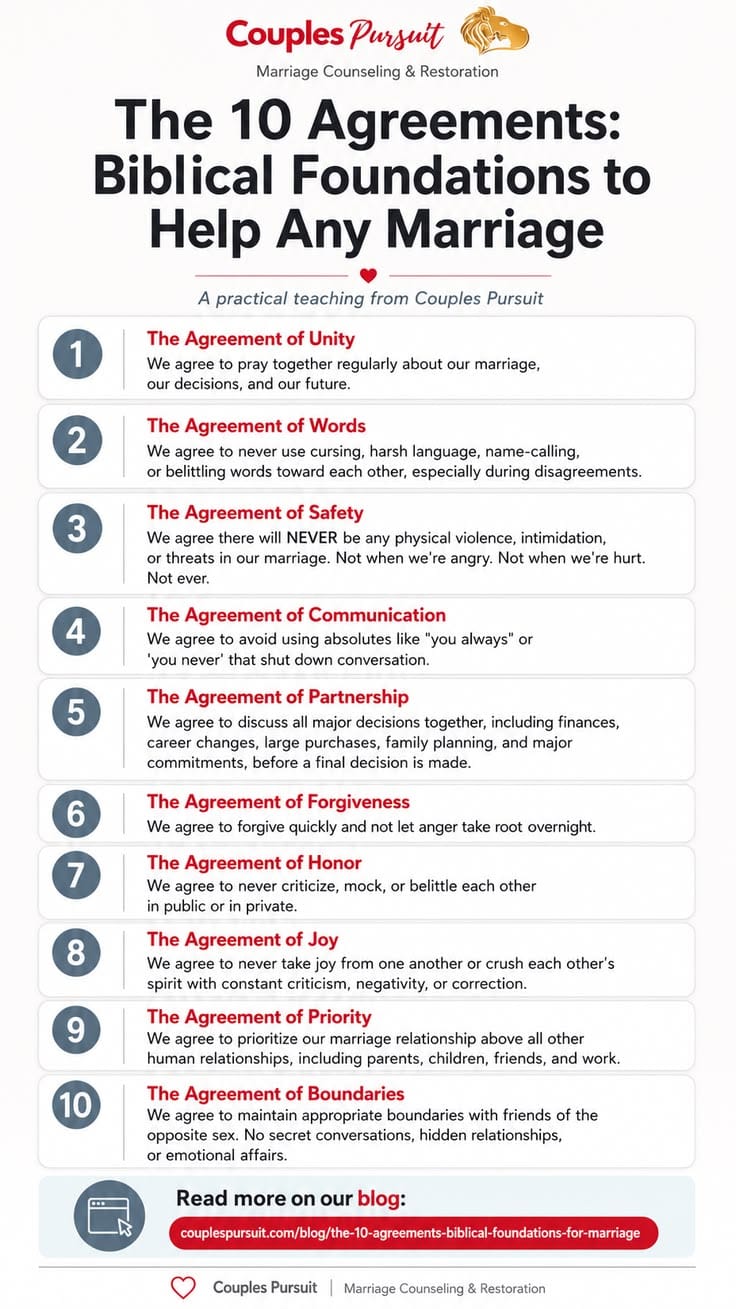
The 10 Agreements: Biblical Foundations to Help Any Marriage

What every couple needs to decide before the problems start, and revisit long after they do
Most couples never actually agree on how their marriage will work. They assume. These 10 biblical agreements give you a framework to decide together, before problems start and after they do.
In This Article:
Here is a question most married couples have never been asked directly.
When did you and your spouse actually sit down and decide how your marriage would work?
Not the wedding planning. Not the honeymoon. Not the early conversations about where to live or whether to have kids. But the real decisions. How you would handle conflict.
What words would never be acceptable between you. What boundaries would protect the marriage from the outside. What you would do when one of you messed up.
How you would treat each other when you were hurt, angry, or disappointed.
For most couples, the honest answer is: we never did.
They assumed. They hoped. They figured it out as they went.
And for some things, that works fine.
For others, it becomes the source of the arguments that repeat themselves for years, because two people are operating by different internal rulebooks that were never compared, never negotiated, never written down.
That is what the 10 Agreements are designed to fix.
These are not rules imposed from the outside. They are decisions a couple makes together, rooted in what the Bible actually says about how a husband and wife are supposed to treat each other.
They cover the things that most marriages never talk about clearly until something goes wrong. The goal is to get ahead of the problem, or to return to solid ground after the problem has already happened.
Read them together. Talk about each one honestly. Adjust the language where needed to fit your specific situation. Then commit to them together, not as a performance, but as a covenant.
This post is part of our complete guide to Covenant in marriage. Read the full guide here.
Why Most Couples Are Operating Without an Agreement
Think about every other significant commitment in your life. When you signed a lease, you read what you were agreeing to. When you started a job, there was an offer letter. When you opened a bank account, there was a terms of service document. Most people spend more time reviewing the fine print on a car purchase than they spend deciding how their marriage will actually function.
That is not a criticism. It is just the reality of how most people enter marriage. You love each other. You made vows. You believe in the covenant. But the vows were poetic and the covenant was spiritual, and nobody handed you a practical document that said: here is how we have agreed to handle money, conflict, extended family, boundaries, and the times when one of us fails the other.
The result is that most marriages are quietly governed by unspoken expectations. Each person assumes the other person shares their understanding of how things should go. And when reality does not match the assumption, the argument is almost never about the surface issue. It is about a standard that was never agreed upon.
Amos 3:3 asks: "Can two walk together, unless they are agreed?" (NKJV) That verse is the foundation of the fifth agreement. But the honest answer for many couples is no. They are walking in roughly the same direction but by different paths, with different maps, and wondering why they keep ending up in different places.
The 10 Agreements are a map you build together.
The Setup: Agreements 1-5
Foundation and Daily Practices
These five agreements form the foundation of how a marriage operates on a daily basis. They address the basics that most couples assume are in place but never explicitly decide.
Agreement 1: The Agreement of Unity
We agree: To pray together regularly about our marriage, our decisions, and our future.
"Unless the LORD builds the house, those who build it labor in vain." (Psalm 127:1, NKJV)
We will seek God's wisdom before seeking everyone else's opinions. We will grow spiritually together and encourage each other's relationship with God. Our marriage will be built on faith, not just feelings.
The biblical order of the family pictures it like four umbrellas stacked on top of one another. At the top is Christ, covering the husband and the entire household. Under Christ is the husband, whose covering rests over his wife and children.
Under the husband's covering is the wife. And under both of them are the children. All four umbrellas are connected by the same handle, held together under God's design for the family.
Why it matters: A three-stranded cord is not quickly broken. When God is at the center, you have strength beyond your own. A marriage built on feelings alone will not survive the seasons when the feelings are gone.
"Most couples spend more time reviewing the fine print on a car purchase than they spend deciding how their marriage will actually function."
Agreement 2: The Agreement of Words
We agree: To never use cursing, harsh language, name-calling, or belittling words toward each other, especially during disagreements.
"Let no corrupting talk come out of your mouths, but only such as is good for building up." (Ephesians 4:29, NKJV)
Our words will build up, not tear down. When we are angry, we will pause before we speak. Sarcasm used as a weapon has no place in our marriage.
Why it matters: Words create reality. Once spoken, they cannot be taken back. The tongue has the power to build a marriage or burn it down. Most of the wounds couples carry from each other were delivered by words, and most of those words were spoken in moments of anger that passed. The marriage keeps the scar long after the anger is gone.
Agreement 3: The Agreement of Safety
We agree: There will never be any physical violence, intimidation, or threats in our marriage.
"Love does no harm to a neighbor." (Romans 13:10, NKJV)
Not when we are angry. Not when we are hurt. Not ever. If we feel unsafe emotionally or physically, we commit to seeking help immediately from a pastor, counselor, or trusted mentor.
Why it matters: Safety is the foundation of intimacy. Without it, nothing else can grow. A marriage where one or both spouses do not feel physically and emotionally safe is not a marriage in God's design. It is a situation that requires immediate outside help.
Agreement 4: The Agreement of Communication
We agree: To avoid using absolutes like "you always" or "you never" that shut down conversation.
"Therefore each of you must put off falsehood and speak truthfully." (Ephesians 4:25, NKJV)
We will use "I feel" statements instead of accusations. We will listen to understand, not just to respond. We will ask questions before making assumptions about each other's motives. We will learn to disagree without it becoming a fight.
Why it matters: Absolutes create defensiveness and shut down real conversation. Honest, specific communication opens the door to understanding and resolution. The word "always" and the word "never" are almost always wrong, and they almost always make the other person stop listening before the real conversation can begin.
Agreement 5: The Agreement of Partnership
We agree: To discuss all major decisions together, including finances, career changes, large purchases, family planning, and major commitments, before a final decision is made.
"Can two walk together, unless they are agreed?" (Amos 3:3, NKJV)
We will be completely transparent about money, spending, and debt. We will not hide financial decisions or operate in secrecy.
Scripture calls us to "submit to one another out of reverence for Christ" (Ephesians 5:21, NKJV). The husband is the head of the home and the wife is called to honor that leadership. And a wise husband leads by seeking wise counsel that includes his wife's input and perspective. The goal is not determining who is right. It is finding what is right for the family together.
Why it matters: Financial secrets and unilateral decisions destroy the trust that partnership requires. When one spouse is consistently making major decisions alone, the other spouse stops feeling like a partner and starts feeling like a dependent. That gap creates resentment faster than almost anything else.
The Maintenance: Agreements 6-8
Relational Health
These three agreements address what couples fail to maintain over time. Forgiveness, honor, and joy are usually the first things to erode when life gets hard. By the time most couples seek help, these three are nearly gone.
Agreement 6: The Agreement of Forgiveness
We agree: To forgive quickly and not let anger take root overnight.
"Be kind to one another, tenderhearted, forgiving one another." (Ephesians 4:32, NKJV)
We will not keep score or bring up past resolved issues as ammunition in current arguments. When we mess up, we will apologize sincerely and mean it. When we are hurt, we will extend grace. We will focus on restoration, not on being right.
One important note: when your spouse comes to you with something on their heart, do not use that moment to introduce your own unresolved concerns. That is deflection, not communication. If you have an issue, address it in a separate, intentional conversation, not in response to theirs.
Why it matters: Unforgiveness is a slow poison. The longer you let it sit, the more damage it does. A marriage where both people are keeping score will eventually collapse under the weight of the scoreboard.
For more on the critical difference between forgiving and actually healing, the post Why Forgiveness Isn't Enough to Heal Your Marriage goes deeper on this specific tension.
Agreement 7: The Agreement of Honor
We agree: To never criticize, mock, or belittle each other in public or in private.
"Honor one another above yourselves." (Romans 12:10, NKJV)
We will not complain about each other to family or friends. We will speak well of each other and defend each other when others criticize. We will show appreciation daily and never take each other for granted. We present a united front to the world.
There is a fine line between seeking wise counsel and tearing down your spouse. Protect your marriage even in your conversations outside of it.
One important boundary: this agreement does not mean staying silent about anything that is abusive, dangerous, or life-threatening. In those situations, secrecy protects harm. Wisdom seeks help.
Why it matters: How you speak about your spouse to others shapes how you see them over time. If you have been venting to your mother, your best friend, or your coworker for years about everything your spouse does wrong, you have been building a case against them in your own mind. Protect their reputation like you would protect your own.
Agreement 8: The Agreement of Joy
We agree: To never take joy from one another or crush each other's spirit with constant criticism, negativity, or correction.
"A joyful heart is good medicine, but a crushed spirit dries up the bones." (Proverbs 17:22, NKJV)
We will celebrate each other's wins and encourage each other's dreams. We will not compare our marriage to anyone else's highlight reel. We will find contentment in what God has given us and protect the joy in our relationship.
Why it matters: Joy is fragile. It is easy to become each other's biggest critic instead of each other's biggest cheerleader. Comparison kills contentment. A joyless marriage is a dying marriage. And many couples do not realize how much joy has been quietly drained out of the relationship until they cannot remember the last time they genuinely laughed together.
The Protection: Agreements 9-10
Guarding What Matters
These final two agreements protect the marriage from the forces most likely to displace it. Priority and boundaries are where most marriage problems have their deepest roots.
Agreement 9: The Agreement of Priority
We agree: To prioritize our marriage relationship above all other human relationships, including parents, children, friends, and work.
"Therefore a man shall leave his father and mother and hold fast to his wife." (Genesis 2:24, NKJV)
We will protect dedicated time for each other. We will keep dating each other. We will not let kids, careers, or other obligations consistently override our commitment to each other. Our marriage comes first, right after God.
Why it matters: What you do not prioritize, you eventually lose. Your marriage will not thrive on leftover time and energy. The post We're Building Everything Except Each Other is specifically for the couple who has let ambition quietly take the marriage's place at the top of the priority list.
Agreement 10: The Agreement of Boundaries
We agree: To maintain appropriate boundaries with friends of the opposite sex.
"Flee from sexual immorality... honor God with your bodies." (1 Corinthians 6:18-20, NKJV)
No secret conversations, hidden relationships, or emotional affairs. We will be transparent about our phones, passwords, and social media. We protect our marriage by protecting it from interference.
Why it matters: Boundaries are not about distrust. They are about protection. You build fences around what you value most. The couples who say "I trust my spouse, we don't need those kinds of rules" are often the ones who find themselves in a counselor's office a few years later, wondering how it happened. The fence is not a sign that the relationship is weak. It is a sign that the relationship is worth protecting.
Bonus Agreements Worth the Conversation
Beyond the 10 core agreements, there are five additional areas that every couple benefits from discussing explicitly. These do not carry the same foundational weight, but they address situations that consistently create conflict in marriages that never talked about them.
Bonus 1: The Technology Boundary "Guard your heart above all else, for it determines the course of your life." (Proverbs 4:23, NKJV) We agree to set boundaries around phones and devices during meals, conversations, and quality time. We will not use technology to avoid each other or to air our marriage issues publicly on social media.
Bonus 2: The Conflict Cool-Down "Everyone should be quick to listen, slow to speak and slow to become angry." (James 1:19, NKJV) We agree to take a timeout when arguments get too heated, but we will always come back to finish the conversation. We will not use silence as punishment. If one of us says "I need a break," that person is responsible for reengaging within 24 hours.
Bonus 3: The Third-Party Wisdom "Where there is no guidance, a people falls, but in an abundance of counselors there is safety." (Proverbs 11:14, NKJV) We agree to seek biblical counsel from a pastor, counselor, or trusted mentor when we cannot resolve issues alone. We will get help early, not as a last resort. We will be humble enough to admit when we need outside wisdom.
Bonus 4: The Intimacy Protection "Marriage should be honored by all, and the marriage bed kept pure." (Hebrews 13:4, NKJV) We agree never to use physical intimacy as a weapon, punishment, or bargaining chip. We will pursue each other with consideration for each other's needs. When physical changes arise, we agree to keep pursuing solutions together and not give up on intimacy in our marriage.
Bonus 5: The Extended Family Respect "Honor your father and your mother." (Exodus 20:12, NKJV) We agree to honor each other's families but maintain healthy boundaries. We will not allow parents, siblings, or in-laws to interfere in our marriage decisions or come between us. We will discuss and agree on holiday plans, visits, and family involvement together.
How to Actually Use These in Your Marriage
Reading through the 10 Agreements is one thing. Letting them actually change how your marriage operates is another. Here is how to make that happen.
First, read them together. Not separately and then compare notes. Sit down, go through each one, and talk about what it means specifically in your marriage. Some will feel obvious. Others will surface a conversation you have been avoiding for years. That conversation is the point.
Second, customize where needed. Agreement 5 on partnership mentions agreeing on a dollar amount for purchases above which you will consult each other. That number is different for every couple. Fill in the specifics that fit your actual situation, your income, your stage of life, and your history.
Third, sign and date them. Not because a signature makes it legally binding, but because making a written covenant together is a biblical act. It marks a moment. It gives you something to return to. It makes the agreement real in a way that a conversation alone does not.
Fourth, review them annually. Your anniversary is the natural time. Pull them out and ask each other honestly: how are we doing against the standards we set? Where have we drifted? What needs to be reaffirmed? Calibration is not a one-time event. It is a practice.
Fifth, show grace when you fail. And you will fail. These agreements are not weapons to use against each other when one of you falls short. They are aspirations that both of you are working toward. When one of you misses the mark, the agreement gives you a standard to return to, not ammunition to use in the next argument.
These agreements are not about creating a perfect marriage. They are about creating a safe one. A marriage where both people know what they have agreed to, what they can count on from each other, and where to return when things get off track.
That is what God designed the covenant of marriage to be. A known standard. A safe place. A commitment you keep returning to, together.
Where to Start This Week
You do not have to tackle all 10 at once. Most couples who try to work through the entire list in one sitting lose momentum somewhere around Agreement 6. Give the process the time it deserves.
Step 1: Pick the two or three agreements you have never explicitly talked about.
Read through the full list and identify the ones that feel the most unresolved or untested in your marriage. Start there. Those are the agreements you need the most. Starting with the easy ones first is natural, but the harder ones are where the real work is.
Ask your spouse: Which of these agreements do you feel like we have never actually settled between us?
Step 2: Have one honest conversation about the agreement that makes you the most uncomfortable.
Resistance is a signal. If one of the agreements made you want to skip past it, that is probably the one your marriage most needs to address. Bring it up with no agenda except honesty. Tell your spouse: "I want to talk about this one specifically because I think we have been handling it by assumption and I want us to actually decide."
Ask yourself: Which agreement am I most hoping my spouse does not bring up? That is the one we need to talk about first.
Step 3: Commit to the review.
Before you finish the conversation, set a date to come back to the full list together. Your anniversary works well. So does the beginning of a new year. The agreements mean more when you commit to revisiting them rather than treating the first reading as a one-time event.
Ask your spouse: Can we agree right now to sit back down with these in 30 days and check in honestly?
Not Sure Where to Begin?
Most marriage issues are not the real issue. The fighting, the distance, the unresolved arguments are symptoms. Underneath all of them is one of 5 root causes.
Take the free 5-minute 5 Marriage Mandates Assessment to find out which root needs the most attention in your marriage right now. No right or wrong answers. Just honest ones.
Or book a free 15-minute session at couplespursuit.com/talk and let us help you find it together.
Join a community of couples choosing to pursue each other at facebook.com/groups/couplespursuit.
Free Resources
These posts go deeper on the specific agreements and principles covered here.
Covenant Marriage Guide - The complete guide to what covenant actually means and why it changes everything about how you fight, forgive, and stay.
Why Forgiveness Isn't Enough to Heal Your Marriage - The critical difference between forgiving and actually healing, and why collapsing them causes more pain.
Healthy Boundaries in Marriage - What the Calibration Mandate means and how boundaries protect what matters most in your marriage.
We're Building Everything Except Each Other - For the couple who is succeeding at everything except prioritizing the marriage itself.
The ODD Conversations Framework That Stops Marriage Fights - A practical guide to navigating the hard conversations that Agreements 2, 4, and 6 require.
Your Marriage Has Drifted. You Just Haven't Said It Out Loud Yet. - How to recognize when the standards you agreed to have slipped and what to do about it.

Vincent and Valerie Woodard are the founders of Couples Pursuit. Married since 2000, they specialize in restoring marriages that feel beyond repair using biblical principles. Connect with them at www.couplespursuit.com.
Want more posts like this one?
We send practical, biblical marriage help to your inbox.
No spam. Just honest content for real couples.
Need to Talk?
Are You Tired of Feeling Disconnected From Your Spouse or Future Spouse?
Book Your FREE 15-Minute
Strategy Session Today!
Our Coaching is based on:
The 5 Marriage Mandates™
Method
Many books offer quick fixes or surface-level advice. But “The 5 Marriage Mandates™” dives deep, addressing the real challenges couples face today.

What Is the Root Issue in Your Marriage?
Take the Free 5 Marriage Mandates™ Quiz. No right or wrong answers...
Just honest ones.

Are You Tired of Feeling Disconnected From Your Spouse or Future Spouse?

FREE 15-Minute Strategy Session
Book Your FREE 15-minute Relationship Restoration Roadmap call with Vincent & Valerie TODAY!
*We respect the rights of all individuals. However, our services may not be appropriate if you identify as LGBTQ, have an untreated addiction, are being physically abused, or are currently involved in an extramarital relationship.




Couples Pursuit is a subsidiary of Woodard Worldwide LLC.
@2026 Couples Pursuit | Privacy policy | Legal | Terms & Conditions