What Is the Root Issue in Your Marriage?
What Is the Root Issue in Your Marriage?

Marriage Counseling & Restoration
You Know You Feel Something. But Can You Name It?

Why naming your emotion is the first step to being understood in your marriage
Most couples don't have a communication problem. They have a vocabulary problem. When you can't name what you actually feel, your spouse can't understand you. This post teaches you how to go deeper.
It happened on a Wednesday night.
Renata had been quiet since her husband Isaiah got home. Not cold, not angry. Just quiet. He asked her twice if she was okay. She said yes both times. He went back to the TV.
By the time they got into bed, something had shifted in the room and neither of them knew what it was.
"What's wrong?" he finally asked in the dark.
"Nothing," she said. And then, ten seconds later: "I just feel some type of way."
That phrase.
Some type of way. Isaiah did not know what to do with it. Neither did Renata, honestly. She knew something was sitting on her chest, but she could not get a name on it. So she said nothing. He assumed it would pass.
It did not pass.
By the time they came to see us, that Wednesday night had replicated itself dozens of times.
The pattern was always the same. Something would happen. Renata would feel it but could not name it. Isaiah could not help with something that had no name. Both of them would go quiet.
The gap between them got a little wider each time.
Here is what we told them.
Renata did not have a communication problem. She had a vocabulary problem. And it was not her fault.
This post is a companion to our teaching on the Semáforo Model. Read that post here.
Why Emotion Is the First Language
Before you spoke a single word, you were already communicating. Every cry you made as an infant was a complete sentence. The hunger cry was different from the pain cry was different from the loneliness cry. Your caregivers learned to read them. Not because you had words. Because you had feelings.
The words came later. The feelings were always first.
Most people grew up emotionally fluent but verbally illiterate. Families taught manners, taught respect, taught how to behave. They rarely sat down and named what was happening underneath behavior. So most of us arrive in marriage able to feel everything and say almost nothing accurate about what we are actually feeling.
Romans 8:26 says: "The Spirit Himself makes intercession for us with groanings which cannot be uttered." (NKJV) God meets us at the pre-verbal level. He understands what we cannot say. But our spouse is not the Holy Spirit. They need words. And when we cannot give them words, we give them guesses, and guesses in marriage almost always land wrong.
Here is the other thing nobody says plainly. The argument is almost never about what it sounds like. The fight about the dishes is not about the dishes. The tension after the grocery trip is not about the groceries.
Underneath the surface issue is an emotion. Underneath the emotion is a need. And the need has been trying to get your attention, through your behavior, through your silence, through your tone, because it does not know how else to get through.
Your job is to learn to translate. To go from what you said to what you actually meant. And the Heart-Level Wheels are how you do that.
"If you tell your spouse you are angry, they brace for impact. If you tell them you are afraid, they lean in."
The Four Levels: From Surface to Need
Every emotion you feel in a marriage has four layers to it. Most couples never get past the first one. Here is what the full journey looks like.
Level 1: The Surface Word. This is what comes out first. "I'm fine." "I'm frustrated." "I don't know." "I just feel off." It is the word that is easiest to say but least accurate about what is actually happening. It is the door, not the room.
Level 2: The Soft Spot. Underneath the surface word is the emotion that is actually driving it. Fine is usually guarded, numb, or resigned. Frustrated is usually unheard, helpless, or dismissed. These are the real feelings. They are more specific. They are more vulnerable. And they are far more useful for your spouse to hear.
Level 3: The Core Message. Underneath the soft spot is the message the emotion is trying to send. It usually sounds like: "It told me that I am invisible to you." Or "It told me I don't matter as much as everything else." The core message is where the real wound lives.
Level 4: The Need. Underneath the core message is a relational need that is not being met. Security. Respect. Love and belonging. Delight. Purpose. Legacy. Physical care. These are the seven needs that were present before you had words for them, and they are the ones your marriage either feeds or starves, day by day.
Most couples fight at Level 1. They throw surface words at each other and wonder why nothing gets resolved. The Heart-Level Wheels give you a map to travel from Level 1 all the way down to Level 4, which is the only level where real understanding lives.
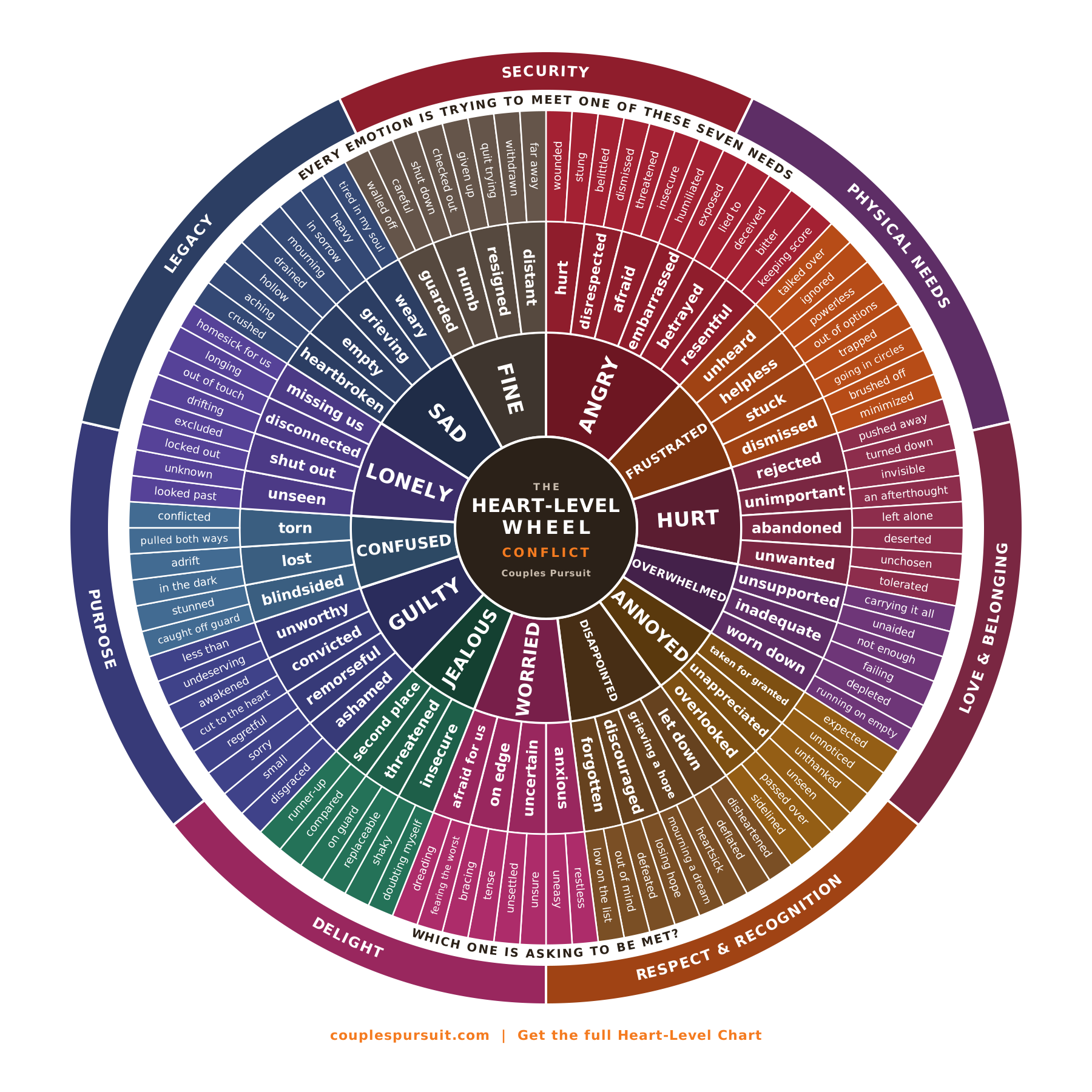
The Conflict Wheel: Naming What Hurts
The Conflict Wheel gives you a vocabulary for pain. It starts with 13 surface doors, the words most people say when something is wrong. Angry. Frustrated. Hurt. Overwhelmed. Annoyed. Disappointed. Worried. Jealous. Guilty. Confused. Lonely. Sad. Fine.
That last one is the most important. Fine is not an emotion. Fine is a wall. When someone says "I'm fine" in a marriage, the Conflict Wheel shows you what is usually behind that wall: guarded, numb, resigned, distant. Those are not comfortable words to say out loud. But they are honest ones. And honest is what makes a real conversation possible.
Inside each door are the soft spots, more specific words that live underneath the surface. Angry, for instance, breaks down into hurt, disrespected, afraid, embarrassed, betrayed, or resentful. Each of those opens a different conversation than "I'm angry." If you tell your spouse you are angry, they brace for impact. If you tell them you are afraid, they lean in.
A few doors on the Conflict Wheel deserve special attention.
Lonely earned its own door because "I feel alone in this marriage" may be the most common sentence spoken in marriage counseling. And loneliness inside a marriage hurts differently than loneliness outside one. You are supposed to be the person who most makes me feel less alone. When you are also the source of my loneliness, there is nowhere to put that.
Guilty is the door built for the spouse who knows they were wrong. Most emotional vocabulary is written from the wounded person's perspective. Guilty gives the person who caused the wound a staircase to walk down honestly. Ashamed. Remorseful. Convicted. Unworthy. These are not comfortable words. But they are the words that open the door to actual repair rather than defensiveness.
Fine is the door for the spouse who has stopped trying to be heard. Guarded. Numb. Resigned. Distant. These words describe someone who still has feelings but has concluded that sharing them is not worth the cost. If your spouse has gone here, something in your history together taught them that going here was safer than the alternative.
The Conflict Wheel does not give you a script. It gives you a starting place. It helps you move from "I don't know what I feel" to "I think I feel this," which is enough to begin a real conversation.
For couples who feel like they have been trying to name their emotions for years and still cannot get through to each other, the post Exhausted From Explaining How I Feel speaks directly to that exhaustion and what to do when the vocabulary is there but the landing never happens.
The Connection Wheel: Naming What Helped
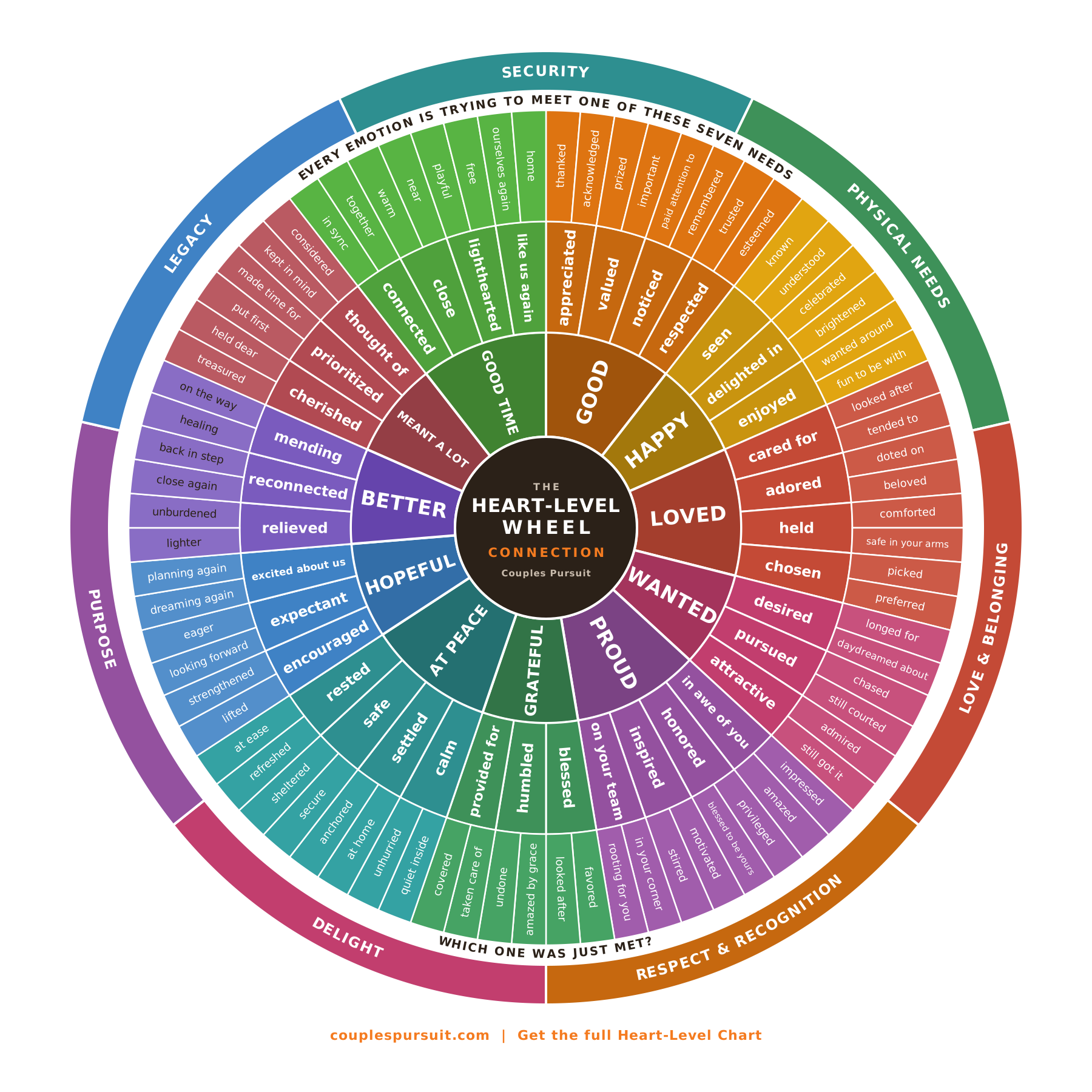
Most emotional tools focus on pain. The Connection Wheel is different. It gives you a vocabulary for the moments when something went right.
This matters more than most couples realize. When you can only name negative emotions, your spouse only knows how to avoid hurting you. They do not know how to reach you. They do not know what to do more of. They do not know what creates the warmth, the closeness, the moments where the marriage feels like it is working.
The Connection Wheel has 11 doors. Good. Happy. Loved. Wanted. Proud. Grateful. At Peace. Hopeful. Better. Meant a Lot. Good Time. Each one opens into soft spots that are more specific and more powerful than the door itself.
Loved breaks down into cared for, adored, held, and chosen. That last one, chosen, is the one that most people in a struggling marriage are starving for. Not loved in a general sense. Specifically chosen. Still picked. Still preferred. The difference between those words matters enormously to the person who needs to hear them.
Wanted, which can feel like a vulnerable door to walk through, breaks down into desired, pursued, still courted, and attractive. These are words that keep a marriage feeling like a pursuit rather than a settled fact. Your spouse needs to know you still see them. The Connection Wheel gives you the words to say it.
At Peace gives language to something that Christian couples experience but often cannot articulate. Calm. Settled. At home. Anchored. Safe. Rested. When your spouse does something that creates that feeling in you, they need to know it. "That made me feel safe" is one of the most powerful sentences one spouse can say to another. But it only gets said when you have the vocabulary to reach it.
The Connection Wheel is also a tool for after a hard season. When a couple has been in conflict and something finally shifts, there are often feelings that need to be named but get lost in the relief. Reconnected. Mending. Lighter. Back in step. Like us again. Those words are the ones that mark the turn in a marriage. Say them out loud when you feel them. Your spouse needs to hear where they landed.
The 7 Relational Needs Underneath Every Emotion
Both wheels are surrounded by the same seven needs. They float in a band around the outside of each wheel, equally present for every emotion, whether the emotion is painful or positive.
Security. The need to know this relationship is stable. That you are not going anywhere. That the foundation holds.
Respect and Recognition. The need to be seen as someone of value. Not just loved in a general sense but specifically regarded as capable, important, and worthy of consideration.
Love and Belonging. The need to be genuinely included. Not tolerated. Not managed. Wanted here.
Physical Needs. The need for physical care, appropriate touch, and the kind of presence that reminds your body it is not alone.
Delight. The need to be someone's favorite. To know that your spouse is glad you exist, not just committed to you, but genuinely lit up by you.
Purpose. The need to feel like your life and your marriage mean something. That you are contributing. That what you do here matters.
Legacy. The need to know that what you are building together will outlast you. That the life you are creating is worth the investment.
These seven needs were present before you had words for them. They were operating in the crib. Marriage did not create them. It just became the closest place for them to ask to be met.
When you use the wheels and you travel from the surface word down to the soft spot to the core message, the question you are ultimately asking is: which of these seven needs is this emotion trying to protect or recover? Answer that question and you have found the real conversation.
How to Use This in a Real Conversation
The wheels are not meant to be used in the middle of a conflict. When you are flooded, activated, and running hot, the last thing you can do is find your way from "angry" to "disrespected" to "it told me I don't matter" to "the need for respect and recognition." That journey requires some calm.
This connects directly to the Semáforo Model. The traffic light system tells you when it is safe to have the conversation. The Conflict Wheel tells you what to say when you get there. They are sequential tools, not competing ones.
Use the Semáforo first to determine your light. Then use the Conflict Wheel to find your words. Read the full Semáforo teaching here.
In practice, using the wheel looks something like this. Before a hard conversation, sit quietly for a few minutes with the Conflict Wheel in front of you. Find the surface door that most matches what you are feeling.
Then read the soft spots underneath it. Which one is more accurate? Which one is closest to the truth? Then ask yourself: what is the core message this feeling is sending? And what need is underneath that message?
By the time you have answered those questions, you have something real to bring to your spouse. Not "I'm frustrated." Something like: "I feel dismissed. And what it's telling me is that my opinion doesn't carry weight with you. What I actually need is to feel like we're deciding things together."
That sentence can be received. "I'm frustrated" cannot. One gives your spouse something to respond to. The other gives them something to defend against.
The same process works with the Connection Wheel, but in reverse. After a moment that felt good between you, try to name it specifically. What door did it open? What soft spot did it reach? Which need did it meet?
Then tell your spouse. "When you did that, I felt chosen. I felt like you still see me." That kind of feedback teaches your spouse exactly what to do more of. It builds the map of how to love you well.
Where to Start This Week
You do not need to master the full vocabulary of both wheels before any of this becomes useful. You just need to go one level deeper than you usually do.
Step 1: Before your next hard conversation, find your door.
When you feel something that you cannot name precisely, pull up the Conflict Wheel and find the surface door that is closest to where you are.
Then read the words underneath it. Find one that is more specific and more honest than the door itself. That is the word you bring to your spouse instead of the surface version.
Ask yourself: If "fine" or "frustrated" is the door, what is the room behind it? What is actually in there?
Step 2: After a good moment, name it out loud.
The next time something your spouse does lands well, do not let it pass without a word. Find it on the Connection Wheel if you need help. Then tell your spouse specifically what it was and what it did.
Not just "that was nice." Something like: "That made me feel seen. It made me feel like you still think about me." That sentence feeds the marriage in a way that silence cannot.
Ask your spouse: Is there something I do that consistently makes you feel this way? I want to know what to do more of.
Step 3: Start with curiosity, not correction.
The next time your spouse says "I'm fine" or gives you a surface response, do not push through it. Instead, ask one gentle question: "What is fine covering up right now?" Or: "What light are you at?"
If they know the Semáforo Model, that question opens a door. If they do not, invite them to read that teaching alongside this one. These tools work best when both people have the same vocabulary.
Ask your spouse: What is one thing I could say or do that would make it easier for you to tell me how you actually feel?
Not Sure Where to Begin?
Most marriage issues are not the real issue. The fighting, the distance, the unresolved arguments are symptoms. Underneath all of them is one of 5 root causes.
Take the free 5-minute 5 Marriage Mandates Assessment to find out which root needs the most attention in your marriage right now. No right or wrong answers. Just honest ones.
Or book a free 15-minute session at couplespursuit.com/talk and let us help you find it together.
Join a community of couples choosing to pursue each other at facebook.com/groups/couplespursuit.
The names and personal details in the stories throughout this post have been changed to protect the privacy of the individuals involved. Any resemblance to specific persons is coincidental.
Free Resources
These posts go deeper on the themes of emotional communication and connection covered here.
Emotions Are Indicators, Not Instructions - The Semáforo Model: how to know which traffic light you are at before you bring an emotion to your spouse.
Communication in Marriage - The complete guide to the Communication Mandate and what it takes to build real understanding between two people.
Exhausted From Explaining How I Feel - For the spouse who has the words but still cannot seem to get through.
My Husband Shuts Down Every Time We Talk - What emotional shutdown actually is, why it happens, and how to create the conditions for the conversation to finally happen.
Your Marriage Doesn't Have a Communication Problem - Why the real issue is not how you talk but whether it feels safe enough to say what you actually mean.
The ODD Conversations Framework That Stops Marriage Fights - The three rules that make it safe to say the hard thing without it becoming a fight.
Four Words That End Every Marriage Fight - A simple reset that changes the trajectory of a conversation that is already going sideways.
Vincent and Valerie Woodard are the founders of Couples Pursuit. Married since 2000, they specialize in restoring marriages that feel beyond repair using biblical principles. Connect with them at www.couplespursuit.com.
Want more posts like this one?
We send practical, biblical marriage help to your inbox.
No spam. Just honest content for real couples.
Need to Talk?
Are You Tired of Feeling Disconnected From Your Spouse or Future Spouse?
Book Your FREE 15-Minute
Strategy Session Today!
Our Coaching is based on:
The 5 Marriage Mandates™
Method
Many books offer quick fixes or surface-level advice. But “The 5 Marriage Mandates™” dives deep, addressing the real challenges couples face today.

What Is the Root Issue in Your Marriage?
Take the Free 5 Marriage Mandates™ Quiz. No right or wrong answers...
Just honest ones.

Are You Tired of Feeling Disconnected From Your Spouse or Future Spouse?

FREE 15-Minute Strategy Session
Book Your FREE 15-minute Relationship Restoration Roadmap call with Vincent & Valerie TODAY!
*We respect the rights of all individuals. However, our services may not be appropriate if you identify as LGBTQ, have an untreated addiction, are being physically abused, or are currently involved in an extramarital relationship.




Couples Pursuit is a subsidiary of Woodard Worldwide LLC.
@2026 Couples Pursuit | Privacy policy | Legal | Terms & Conditions